Confusing press conventions that readers need to understand
The Truth Matters, Chapter Four

This is the fourth chapter of my book, The Truth Matters. Chapter one is here, chapter two is here, chapter three is here.
Key points:
· What do the terms “on-the-record,” “off-the-record,” and “on background” mean?
· How these terms can be abused by sources to mislead reporters
· Don’t be afraid to use these conventions yourself when interacting with reporters.
One of the reasons why news consumers have become dissatisfied with the mainstream media is that journalists follow many conventions that are seldom ever spelled out to readers. Reporters, editors and, sometimes, sources know them, but otherwise they are a sort of black box.
Probably one of the most confusing is the use of terms such as off-the-record. Adding to the confusion, I have found over the years that different reporters and news organizations use this term differently, which can ensnare those inexperienced in dealing with the media and readers alike, creating confusion and embarrassment.
To start with, the term on-the-record simply means that whatever a source says may be quoted directly and that person may be named in the story along with other relevant information, such as their job title and some discussion of what ax they may have to grind. For example, an official spokesperson for a corporation or government agency is not at liberty to give their personal opinion on a matter, they are simply conveying an institutional point of view. Nevertheless, reporters will still try to get the spokesman to say something contrary to the official view in hopes of getting a response that will spice up an otherwise ordinary story.
Off-the-record, in my experience, means that a reporter can quote what you say, but you may not be identified by name or title. You are generally given some very vague description such as “administration official” in order to show that you are in a position to know, but are not authorized to speak for the administration. Some people tend to equate all off-the-record statements with leaks, but they aren’t necessarily. Oftentimes the person being quoted has simply decided to give an exclusive to one media source for strategic reasons and doesn’t want to incur the ire of other news organizations.
However, I know that some news organizations use the term off-the-record more strictly. Back in 2004, Leonard Downie Jr., then executive editor of the Washington Post, said that in his paper’s usage, “off-the-record information may not be used at all, either in the newspaper or in further reporting.” He would call my description of off-the-record to mean “not for attribution.”
In my experience, Downie’s definition of off-the-record is closer to the term “on background.” To me, this has always meant that a reporter can use the information I give her, but I cannot be quoted directly and my name may not be mentioned. I may also want an even more vague description of who I am to avoid getting in trouble with my bosses.
A related term is “deep background.” In this instance, nothing you say to a reporter can be quoted, attributed or written about at all unless it is confirmed by an unrelated source. Information derived from a deep background discussion is simply to guide a reporter’s thinking or research.
Even long after I was out of government, I would still occasionally give interviews to reporters on background or deep background. The reason is that I wanted to speak freely without have to watch every word for fear of inadvertently misstating some fact or point in a way that would be embarrassing to me or harmful to my ideological or political goals. Indeed, some reporters would call me and immediately tell me the discussion was on background to put me at ease because they were just trying to understand something that may or may not end up in a news story.
What I would sometimes do is tell a reporters that they could quote me from a background interview, but that they needed to clear the quote with me in advance. My purpose was simply to make sure I was accurately quoted on some point that might be highly technical or confusing, not to obfuscate. I have never found a reporter unwilling to abide by such a request, which aids both of us by ensuring accuracy while encouraging an open discussion.
Perhaps the master of using these various methods of giving interviews was Ronald Reagan’s White House chief of staff James A. Baker. In that position, he often gave on-the-record interviews expressing the administration’s position on the issues. But sometimes Baker disagreed with those positions, so he would simultaneously give the same reporter an off-the-record comment arguing against the position he had just expressed! On other occasions, he was known to say that the president did not speak for the administration when President Reagan said something publicly that was contrary to some position Baker was fighting to implement or oppose.
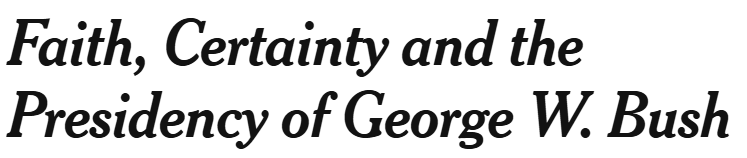
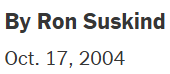
Despite my experience with the media, there are times when I have been caught off-guard. Some years ago I wrote a column praising a book by the Pulitzer Prize winning journalist Ron Suskind. He sought me out and from time to time we would chat about various things the George W. Bush administration was doing. Since he was not at the time employed by any news organization I viewed our conversations as between friends rather than reporter and source.
Then one day I got a call from a New York Times Magazine factchecker, saying that I was being quoted in an upcoming article by Suskind. The factchecker did not read my quotes to me or indicate their context. I was simply asked whether I said this or that and said that I did. I was often quoted in the Times and gave it no further thought.
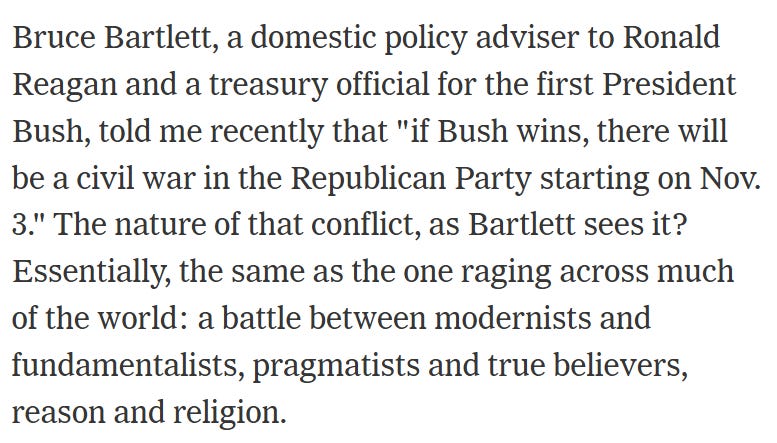
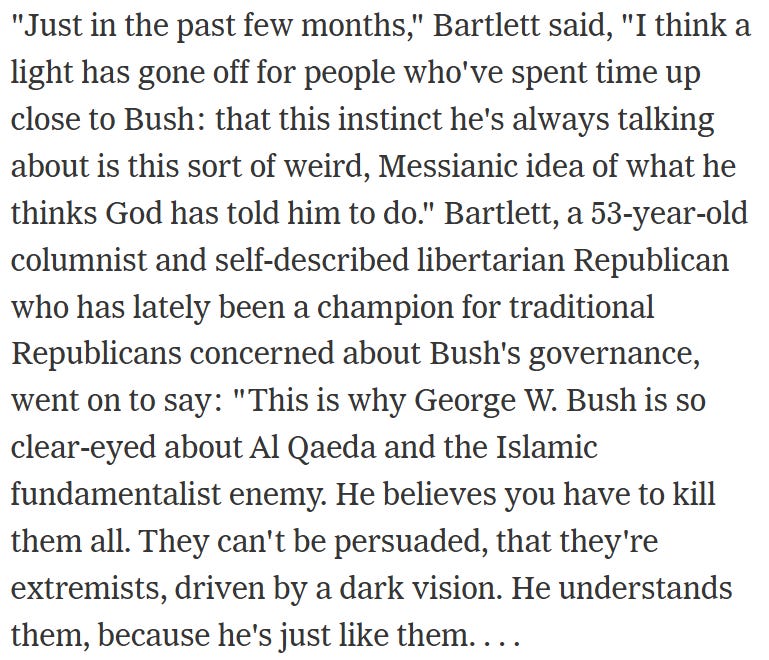
A few days later, however, I learned that the Suskind article had been distributed to news organizations and I was very extensively quoted making disparaging comments about President George W. Bush. Although I was accurately quoted, it was embarrassing to me because I worked for a conservative think tank that was closely allied with the administration. Bush’s top political adviser Karl Rove called my boss directly to complain that I was not being a team player, and I was berated for my comments. I was later fired by this organization after writing a book that was critical of Mr. Bush. Ironically, my principal criticism was that Bush was not sufficiently committed to conservative principles, a view no conservative would disagree with today.
Thus one can see that it is not only those working in government who must be careful what they say to the media. Even those ostensibly free to speak must be careful lest their comments run afoul of some partisan, ideological, religious or other line and subject to you to criticism or even loss of a job.
Needless to say, this problem is very much more difficult today in an era of social media, something that thankfully did not exist when I was in government. Today it is common for reporters to follow everything posted on social media by people who may in some way be newsworthy, and to mine past comments when someone is suddenly thrust into the media’s attention. Employers often do the same; there were several instances early in the Trump administration where people had been hired for administration jobs only to lose them when it was discovered that they had made disparaging comments about Mr. Trump on Twitter or Facebook or elsewhere. Oddly, though, some administration officials who worked for one of his competitors for the Republican presidential nomination, such as Kellyanne Conway who worked for Senator Ted Cruz before switching to Trump, were forgiven for attacks they made against Trump while in that capacity.
What all this means is that being careful about what one says in public is no longer just a problem for those working in government or even those who deal directly with the news media. Trying to keep everything you say private is one strategy, but difficult if you are trying to have a political impact by supporting a certain candidate or political action such as the Women’s March on Washington on January 21, 2017, or simply to vent personal frustration over a governmental policy that isn’t working.
Addendum
For those curious, the Suskind story I reference above is this one (free link here). The quotes from me appeared at the very beginning of the article.